
Carbon Footprint Assessment & Decarbonization Planning
The Climate Corporate Data Accountability Act (SB 253) and the Climate-Related Financial Risk Act (SB 261) introduce new mandates, similar to the federal rules proposed by the US Securities and Exchange Commission (SEC). These mandates apply to virtually all major companies operating within California. SB 253, the Climate Corporate Data Accountability Act, mandates that US companies with annual revenues exceeding $1 billion and conducting business in California disclose their Scope 1 and 2 greenhouse gas (GHG) emissions data starting in 2026, and their Scope 3 GHG emissions data by 2027, with annual reporting thereafter.
Due to the Scope 3 reporting requirement, these mandates will also affect smaller companies that provide goods and services to the large companies subject to SB 253/261. As a result, many small and medium-size companies will have to measure and share their carbon footprint with their clients/customers. In addition, they may have to take action to reduce their greenhouse gas emissions and their carbon footprint.
At Dena Energy, we specialize in empowering businesses to measure, manage, and reduce their carbon footprint with our comprehensive assessment and decarbonization solutions.
What is Carbon Footprint Assessment and Why is it Important?
Carbon Footprint Assessment is a comprehensive assessment that measures the total greenhouse gas emissions produced by an organization. It provides a detailed breakdown of emissions from various sources, such as energy consumption, transportation, waste management, and more. By quantifying your carbon footprint, you can identify key emission sources, set reduction targets, and track progress towards your sustainability goals.
What are GHG Emission Scopes?
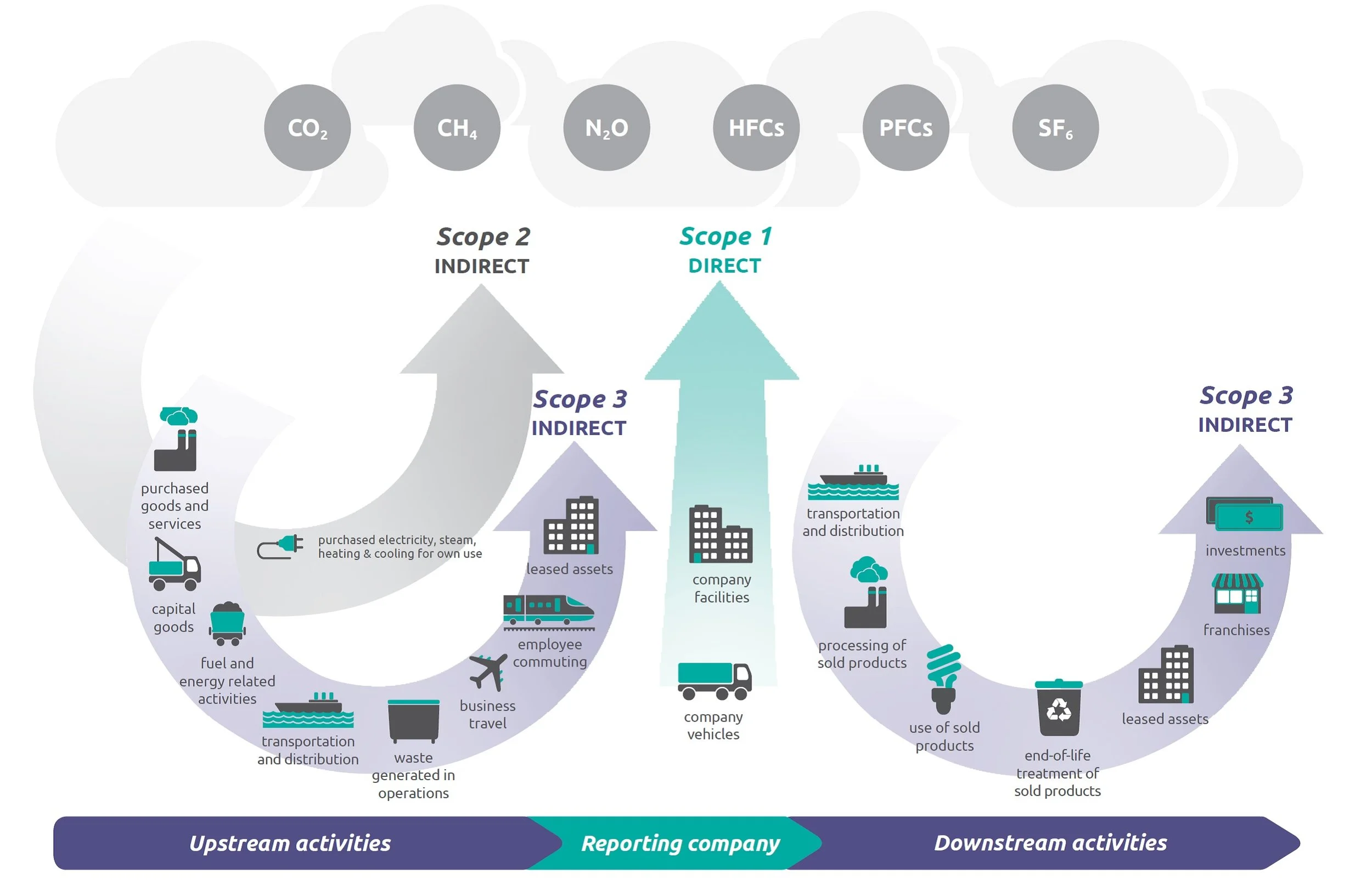
To help delineate direct and indirect emission sources, improve transparency, a three “scopes” (scope 1, scope 2, and scope 3) are defined for GHG accounting and reporting purposes:
Scope 1: Direct GHG Emissions — Direct GHG emissions that occur from sources owned or controlled by the company, for example, emissions from combustion in owned or controlled boilers, furnaces, vehicles, etc.
Scope 2: Electricity Indirect GHG Emissions — GHG emissions from the generation of purchased electricity (that physically occur at the generation facility) consumed by the company.
Scope 3: Other Indirect GHG Emissions — Scope 3 emissions are a consequence of the activities of the company, but occur from sources not owned or controlled by the company. Examples include extraction and production of purchased materials; transportation of purchased fuels; and use of sold products and services.
Decarbonization Planning
At Dena Energy, we have developed a comprehensive framework that can be tailored to meet your organization's unique needs. Here is how how our decarbonization solutions can help your company achieve its sustainability goals:
Comprehensive Carbon Footprint Assessment
Our team of experts will conduct a thorough analysis of your company's carbon emissions across Scope 1 (direct emissions) and Scope 2 (indirect emissions from purchased electricity). By identifying sources of emissions and quantifying their environmental impact, we provide valuable insights to guide your decarbonization strategy.
Tailored Decarbonization Plan
Based on the findings of the carbon footprint assessment, we'll work closely with your team to develop a customized decarbonization plan tailored to your company's unique needs and objectives. Whether it's reducing energy consumption, optimizing resource use, or transitioning to renewable energy sources, we'll help you implement practical solutions to drive meaningful emissions reductions.
Technical Support for Decarbonization
With our expertise in energy efficiency and energy-consuming equipment in commercial and industrial facilities we can provide solutions and technical support for implementation of decarbonization measures. We help our clients implement GHG reduction solutions and prioritize with lowest cost per unit.
Cost Savings and Competitive Advantage
Investing in sustainability isn't just good for the planet—it's good for your bottom line. By reducing energy waste, improving operational efficiency, and embracing clean technologies, our decarbonization solutions can help your company save money, enhance profitability, and gain a competitive edge in the market.
Long-Term Sustainability and Resilience
Our holistic approach to carbon management helps future-proof your company against regulatory changes, market disruptions, and evolving consumer preferences, ensuring long-term sustainability and resilience in a rapidly changing world. By embedding sustainability into your business practices, you're not just preparing for the future—you're shaping it.
Schedule a consultation with our team today to learn more about how our carbon footprint assessment and decarbonization solutions can benefit your business.
Phone: 888-302-DENA (3362)
Email: info@dena.energy